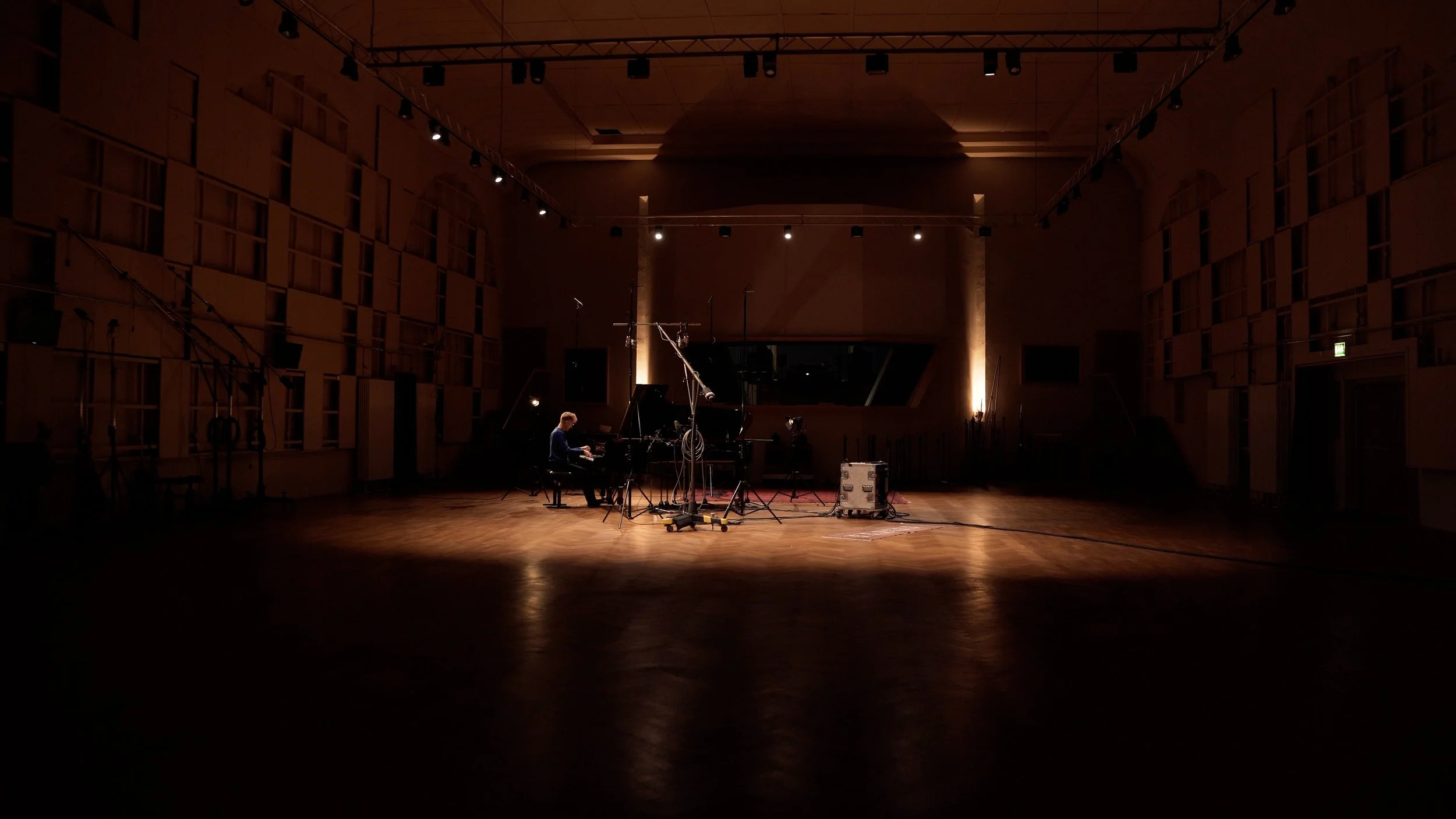
Teldex Studio Berlin
Teldex Studio Berlin
My musical upbringing couldn’t have been more American. Born in Iowa – the very center of the country – with two World War II veterans for grandfathers, my first exposure to music was in the form of folk songs, hymns and old patriotic tunes. It was sort of a Midwestern version of Charles Ives’s New England, only a century later. But what really made my heart pound was the Great American Songbook that my grandmothers shared with me; so I don’t remember a time when the tunes of Irving Berlin, Cole Porter or Jerome Kern weren’t in my ears.
I began piano lessons at six and was eventually practicing the “Three Bs”: Bach, Beethoven and Brahms. I sang in choirs, played trumpet in youth orchestras (a very formative experience), made arrangements for my school choir and jazz band, and conducted ensembles in church and school. This frenzy made no distinction between Handel and Richard Rogers, but ever-present for me was the brightest diamond of them all, George Gershwin. His piano music was my “Well Tempered Clavier,” his “An American in Paris” my Beethoven Fifth Symphony; and as a teenager when I first played piano with orchestra, it was “Rhapsody in Blue.” I fancied that I had conquered a pianistic summit on par with the Rachmaninoff concerti.
A few decades later Zubin Mehta called me an anachronistic American kid when I told him of my love for my grandparents’ music while serving as assistant conductor on Arnold Schoenberg’s monumental “Gurrelieder.” I hadn’t discovered the Second Viennese School – Schoenberg and his pupils Alban Berg and Anton von Webern – until a dry theory class in college when we analyzed Schoenberg’s Piano Piece, Op. 33a. We approached it with gloves on, as if dissecting a toxic amphibian; our scalpels were colored pencils used to circle tone rows. This was all on paper and we never even listened to the music. Yet, despite the noxious way it was presented, I sensed something deeper in these composers. And after taking the plunge into Schoenberg’s Pierrot Lunaire, my relationship with the Second Viennese School turned into an obsession.
This childhood passion and adult obsession were united when I learned that Gershwin and Schoenberg had become friends in California. This historical footnote is usually treated as an ironic factoid, but the artistic connections between Gershwin and the Second Viennese School reveal more than personal affection. The music of these composers deserves to be heard side by side. This album aims to reveal their sympathetic affinities.
“Music is music.” – Berg to Gershwin
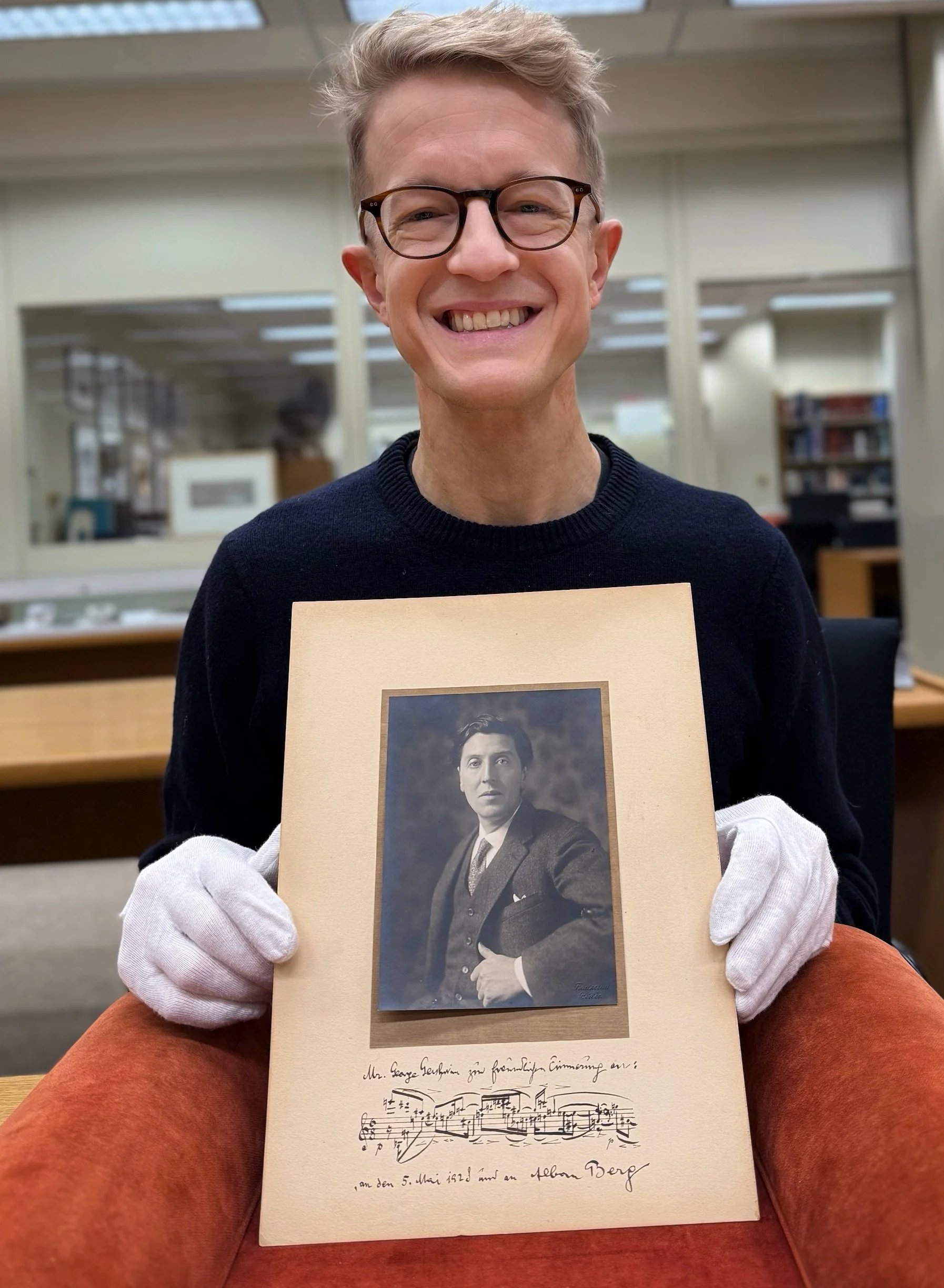
At the Library of Congress with the photograph that Berg inscribed for Gershwin.
George Gershwin – already the celebrated composer of Broadway hits and “Rhapsody in Blue” – traveled to Vienna in 1928 on a European tour. Interwar Vienna still held the allure of the seething fin de siècle world of Klimt, Freud and Mahler. Gershwin had already heard Berg’s Piano Sonata, and when the two met, Berg organized a private performance of his “Lyric Suite” for string quartet. Berg in turn wanted to hear some of his American colleague’s music and Gershwin uncharacteristically demurred, perhaps out of modesty or embarrassment in the presence of a modernist master. Berg’s response is significant: “Mr. Gershwin, music is music.” And thus encouraged, Gershwin sat at the piano, likely playing the Preludes and the “Songbook” piano transcriptions (both on this album) which were in his fingers but which he wouldn’t set to paper for another five years. From this historic meeting Gershwin left Vienna with a signed photograph of Berg inscribed with a few measures of the “Lyric Suite.” I’m certain that the “Lyric Suite” directly influenced “An American in Paris,” which Gershwin had begun earlier that year but finished only after his Vienna trip. In the middle of Gershwin’s tone poem, as the big romantic tune barrels towards its climax, the orchestra dramatically cuts out, leaving only a string quartet for two bars. This highly chromatic passage is smoke from Berg’s cigar wafting from Vienna to Paris via an American genius.
One of Gershwin’s prized possessions was the piano score of Berg’s “Wozzeck,” and he traveled to Philadelphia for that opera’s American premiere in 1931. His own opera, “Porgy and Bess,” owes much to “Wozzeck.” Both operas have onstage pianos: in “Porgy,” there’s the “Jazzbo Brown Blues” (on this album;) in “Wozzeck,” the polka in the tavern scene. Both operas feature haunting lullabies: “Summertime” and “Mädel, was fangst du jetzt an.” And in his hurricane scene, Gershwin emulates the wind following Wozzeck’s drowning. Porgy contains countless Bergian ostinati and fugues, to say nothing of structural and dramaturgical parallels. Clearly, Berg’s influence on Gershwin was profound.
Gershwin never met Anton von Webern, whose Piano Variations, Op. 27 are on this program, but he would certainly have been familiar with him through the other two members of the triumvirate, and he even heard Schoenberg conduct Webern’s Passacaglia, Op. 1 in Los Angeles.
“There is no doubt that he was a great composer.” – Schoenberg on Gershwin
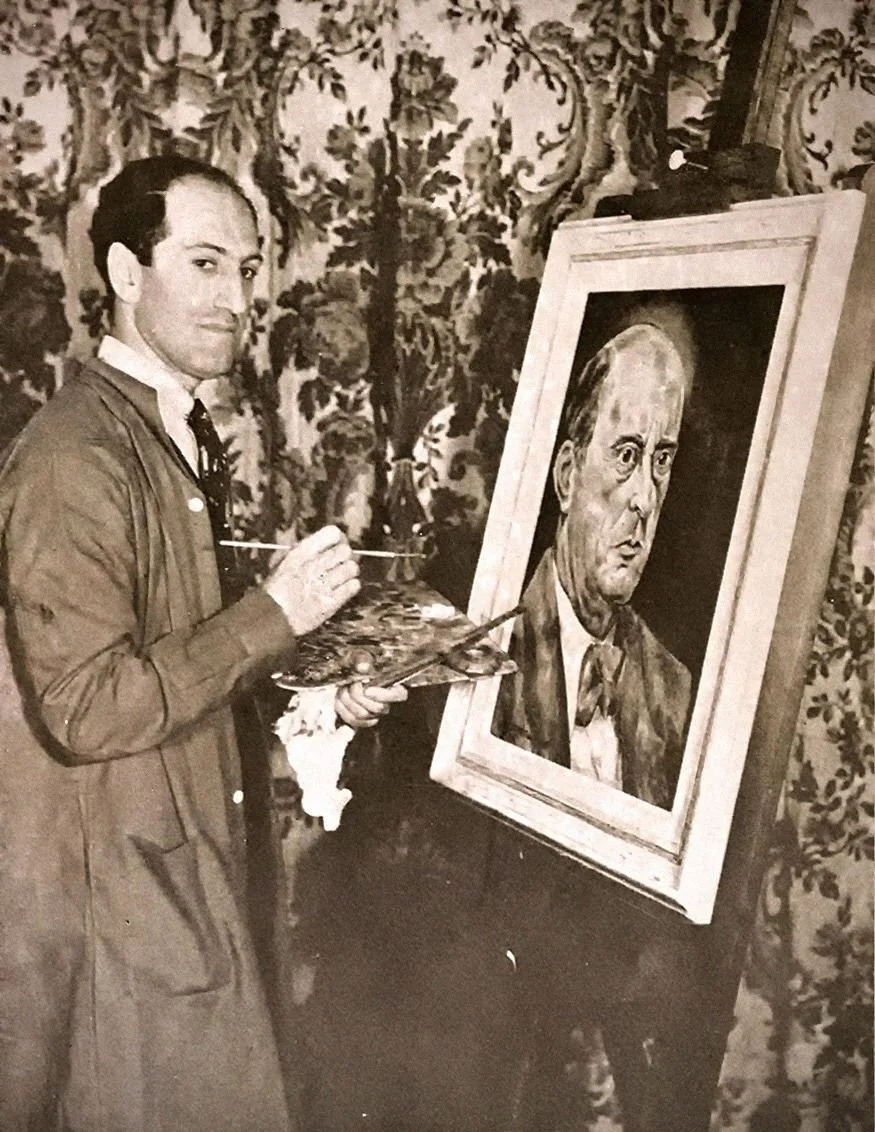
George Gershwin painting a portrait of Arnold Schoenberg, ca. 1934
These words, spoken on the radio by Schoenberg after the death of his friend and colleague, were high praise from a man known for his unflinching honesty. Exactly when and where they met is disputed, but it was most likely in the artistic hothouse of Los Angeles, where Schoenberg had landed along with many other distinguished emigrees escaping an increasingly fascist Europe. After Gershwin’s passing, Schoenberg also wrote a short essay, beginning with a defense: “Many musicians do not consider George Gershwin a serious composer. But they should understand that, serious or not, he is a composer – that is, a man who lives in music and expresses everything, serious or not, sound or superficial, by means of music, because it is his native language.” He goes on to praise Gershwin’s musical ideas, which he views as distinct from superficial style. “It seems to me beyond doubt that Gershwin was an innovator. What he has done with rhythm, harmony and melody is not merely style…. Melody, harmony and rhythm are not welded together, but cast…. he expressed musical ideas; and they were new--as is the way in which he expressed them.”
For two composers with such vastly different backgrounds, Schoenberg and Gershwin mirrored each other in other uncanny ways. Both largely self-taught, both Jewish, both painters, their most important similarity might be their relentless devotion to their craft, refining it their whole lives as they evolved. And they were both tennis players! – often with each other – as can be seen in a film shot partially by Gershwin himself on his own tennis court. The grief Schoenberg felt at his younger friend’s death can be heard in his own thick Viennese accent in the radio speech included at the conclusion of this album.
Schoenberg’s radio speech on Gershwin
I believe Gershwin had a compositional inferiority complex. An autodidact for the most part, he learned music on the bustling streets of New York City. As a song plugger on Tin Pan Alley, he absorbed every crackling style of the time. In this respect he was an American Mozart, prodigiously assimilating everything he encountered. Styles were evolving so quickly that it’s difficult to distinguish them in retrospect, but he was at the very center of New York’s exhilarating musical tumult.
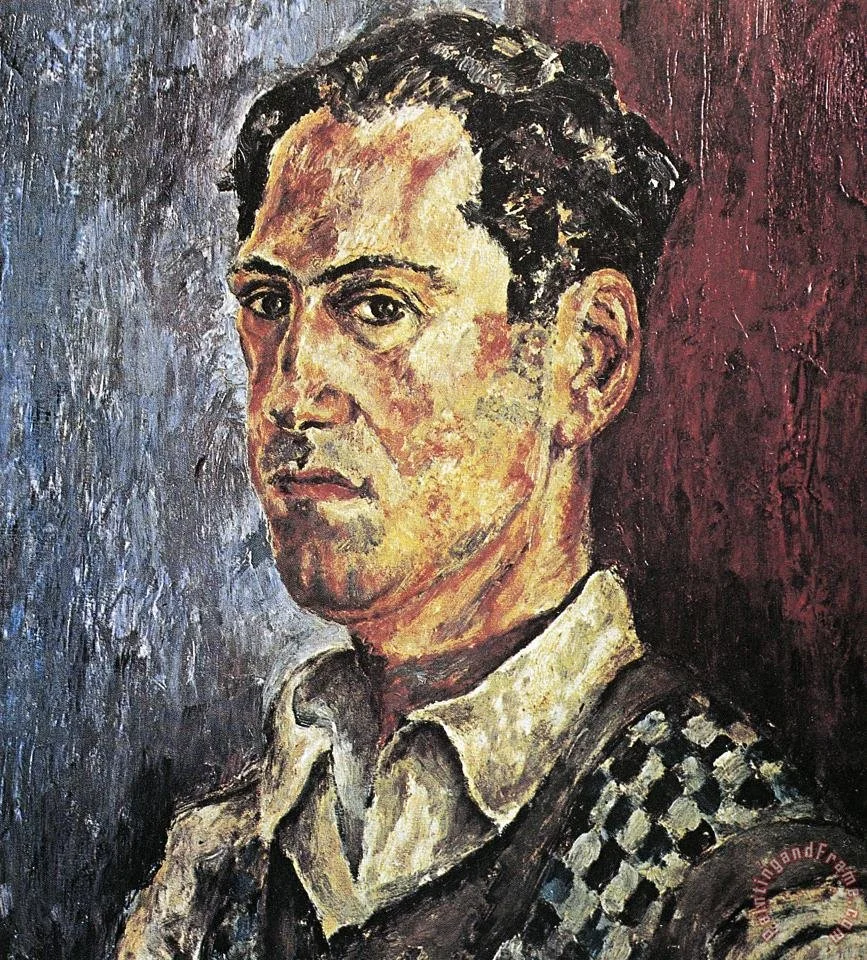
George Gershwin: Self Portrait in a Checkered Sweater (1936)
Without formal training, he felt somehow lacking in the skills of “serious,” i.e. “classical” composers, that fallacious distinction being as prevalent then as it is now. It’s well known that he sought instruction from Ravel, Schoenberg, Berg, Stravinsky and Nadia Boulanger, though it must be admitted that some of these stories are more apocryphal legends than actual fact. But he did end up later taking lessons in harmony and counterpoint from solid theorists.
Gershwin’s interest in musical modernism wasn’t restricted to the Second Viennese School; Debussy’s extended harmonies are present in his “Songbook” piano transcriptions, and Stravinsky’s fingerprints (“Petrushka” especially) are all over “Porgy and Bess.” But the Viennese influence on Gershwin’s aesthetic development is remarkable and pairing their music together illuminates the seriousness of Gershwin’s craft and reveals expressive variety in the Viennese composers. Schoenberg is sometimes branded as an expressionist because of a few masterpieces like “Erwartung.” But that was just one of his manifold styles, and the only expressionistic piece on this album is the third of the Three Piano Pieces, Op. 11. Similarly, Webern is often mischaracterized as a pointillist; this is in part the fault of performers, who for the better part of a century have misinterpreted his music like it’s dry ice, when in fact it should be played like sizzling lava, as if Mahler’s Seventh Symphony were reduced in a centrifuge to the few incandescent drops of Romantic intensity that are Webern’s Piano Variations, op. 27.
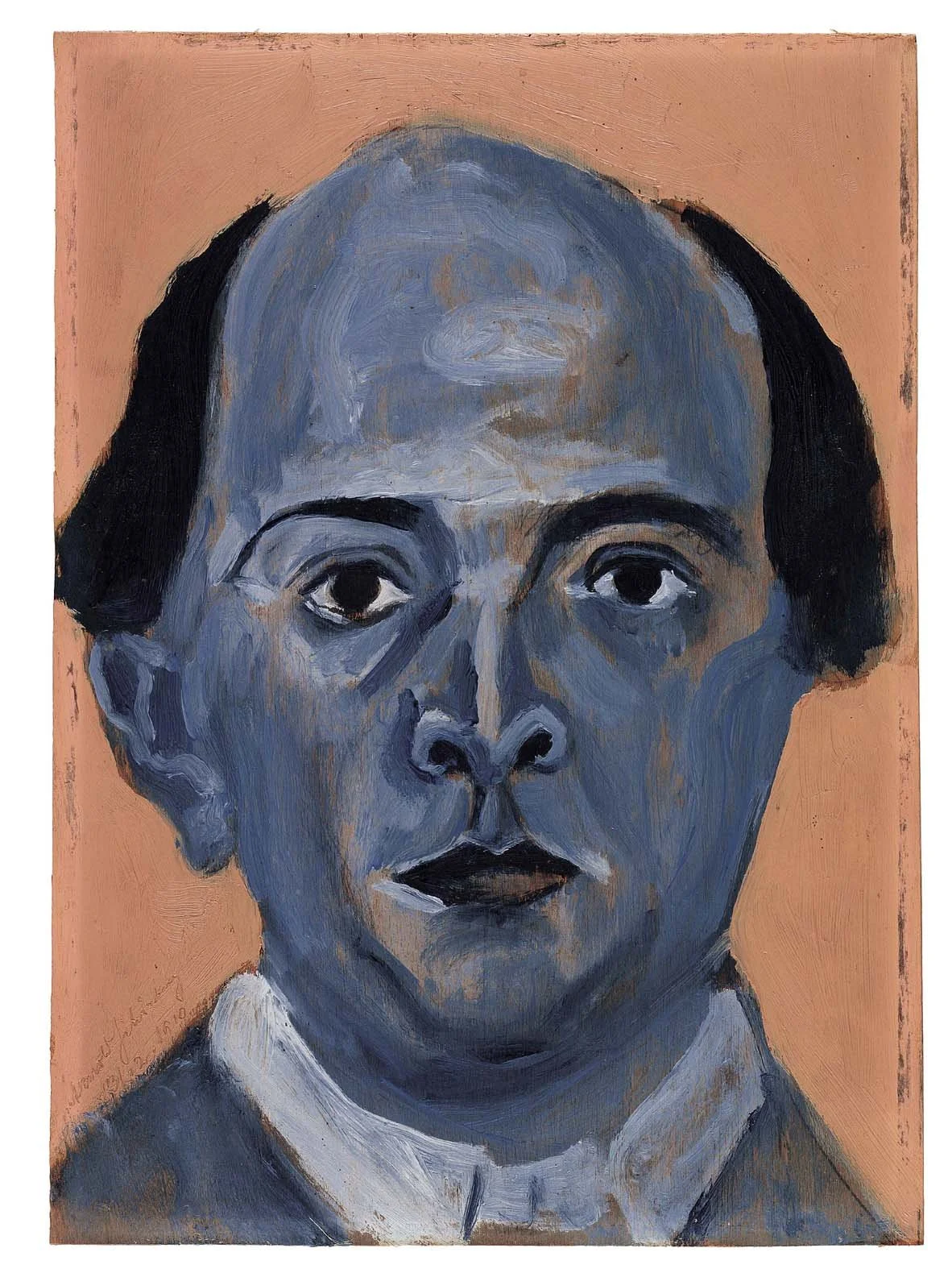
Arnold Schoenberg: Blue Self-Portrait (1910)
Gershwin’s Preludes draw from Tin Pan Alley idioms, and in this sense, he was drawing on the native music of early 20th century America, just as composers from Beethoven to Brahms to Bartok had turned to their own folk music. The adult Gershwin – the celebrity feted coast to coast – was constantly asked to play his hit Broadway tunes on the piano, and the thoughts of a serious composer are revealed in the preface of his “Songbook” piano transcriptions: “Playing my songs as frequently as I do … I have naturally been led to compose numerous variations upon them, and to indulge the desire for complication and variety that every composer feels when he manipulates the same material over and over again. It was this habit of mine that led to ... [the publication of] a group of songs…in the variations that I had devised.” In these transcriptions the mature, modernist Gershwin shines. They are no lesser miniature masterpieces than Mendelssohn’s Songs without Words or Chopin’s Mazurkas.
Gershwin only reached full maturity in “Porgy and Bess.” It’s impossible not to speculate on how he might have developed had his life not been cut so short, just as I wonder how Mozart would have blossomed if the “Jupiter” Symphony were a middle period work rather than the crown of his symphonic output. Certainly, Gershwin’s influence reverberated in composers like Ravel (Piano Concerto in G) and Weill (“Street Scene”.) I’m convinced that Gershwin would have delved ever deeper into modernism, probably in the direction of Berg, since they were both such consummate theater men. Perhaps he would have adopted Schoenberg’s 12-tone method and – like Richard Strauss – later retreated back into a more conservative language. I can’t imagine that Gershwin – the greatest melodist since Schubert – would have ever gone fully dodecaphonic. Speculation is tantalizing, but Schoenberg’s tribute to his friend expresses it best: “And there is no doubt that he was a great composer. What he has achieved was not only to the benefit of a national American music but also a contribution to the music of the whole world. In this meaning I want to express the deepest grief for the deplorable loss to music. But may I mention that I lose also a friend whose amiable personality was very dear to me.”
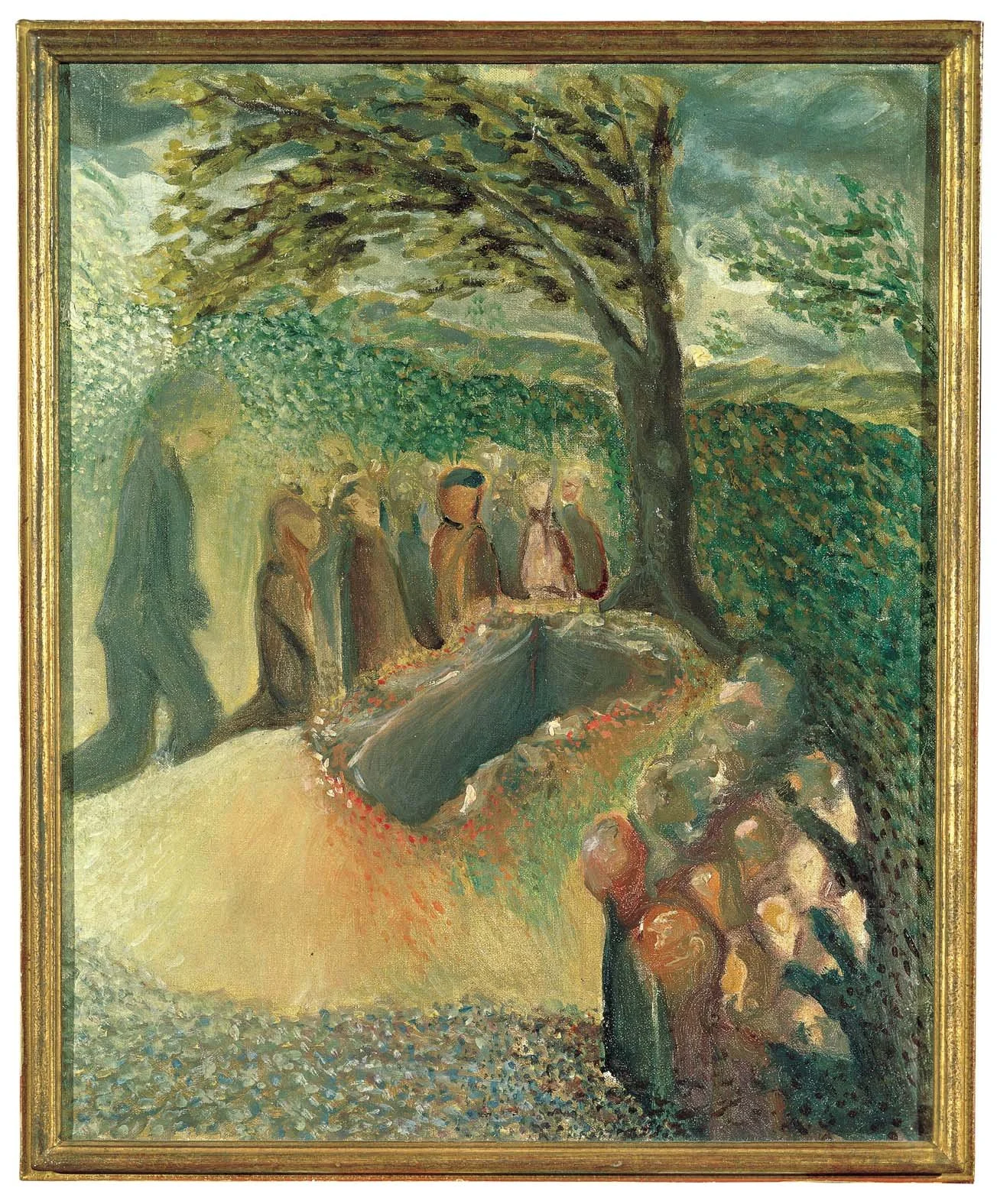
Arnold Schoenberg: The Burial of Gustav Mahler (1911)
“Gershwin in Vienna” weaves together many musical and historical threads, but it is also a kind of self-portrait of my own artistic journey, a diary of my musical development. I’ve always been drawn to many-sided artists like Simon Rattle, Barbara Hannigan, Barrie Kosky, Gustavo Dudamel, or Lorin Maazel, an early mentor of mine for whom Gershwin was as contemporary as Richard Strauss. And as I grew from a child of the Great American Songbook to a conductor and pianist wrestling with the rigorous beauties of the Second Viennese School, my life also became transatlantic after a decade living in Europe. Piano playing remains with me, even as my peripatetic work has embraced the symphonic tradition, early music and opera – Wagner and Mozart especially.
My approach to performing Gershwin has changed over time. As a kid I couldn’t resist the thousands of astoundingly creative renditions by geniuses like Ella Fitzgerald and Louis Armstrong. But to be clear, I’m not a jazz musician – alas! – and I’m now most influenced by Gershwin’s own acoustic recordings (not the controversial piano rolls, which capture only a sterilized shadow of his style.) When Gershwin plays, you hear the sharpness of his wit and the sophistication of his rhythm – so much more subtle than an artificial swing-straight dichotomy. It would be foolhardy to try to imitate Gershwin, but I try to capture his spirit.
Gershwin home movie with Schoenberg (1936)
My attitude to the Second Viennese School has also matured. When first preparing “Pierrot Lunaire,” I mistakenly performed it as an expressionist piece, because of how different it was from anything I had ever done before. All music can be heard in terms of how it builds upon or breaks from that which came before it, and though Schoenberg and his students were indeed revolutionary, they never abandoned their hyper-romantic aesthetic roots. Even in their atonal music, I’m certain that tonality is omnipresent, because the ear exerts a gravitational pull back to harmony; and by so avoiding tonality, they concede its pervasive power. In Schoenberg’s middle, freely atonal period in particular – especially in Opp. 11 and 19 on this album – I can usually hear where atonal material should resolve, but doesn’t – and therein lies his expressive intent.
Gershwin, Schoenberg, Berg and Webern were cut from the same musical cloth, and it is my hope that “Gershwin in Vienna” will spark curiosity and bring listeners the same joy that I’ve experienced in my lifelong devotion to their art.
Levi Hammer, Berlin 2026
“Gershwin in Vienna” is available to stream or purchase on all platforms.
Complete CD booklet here
Hammer Dialogues: “Gershwin in Vienna”
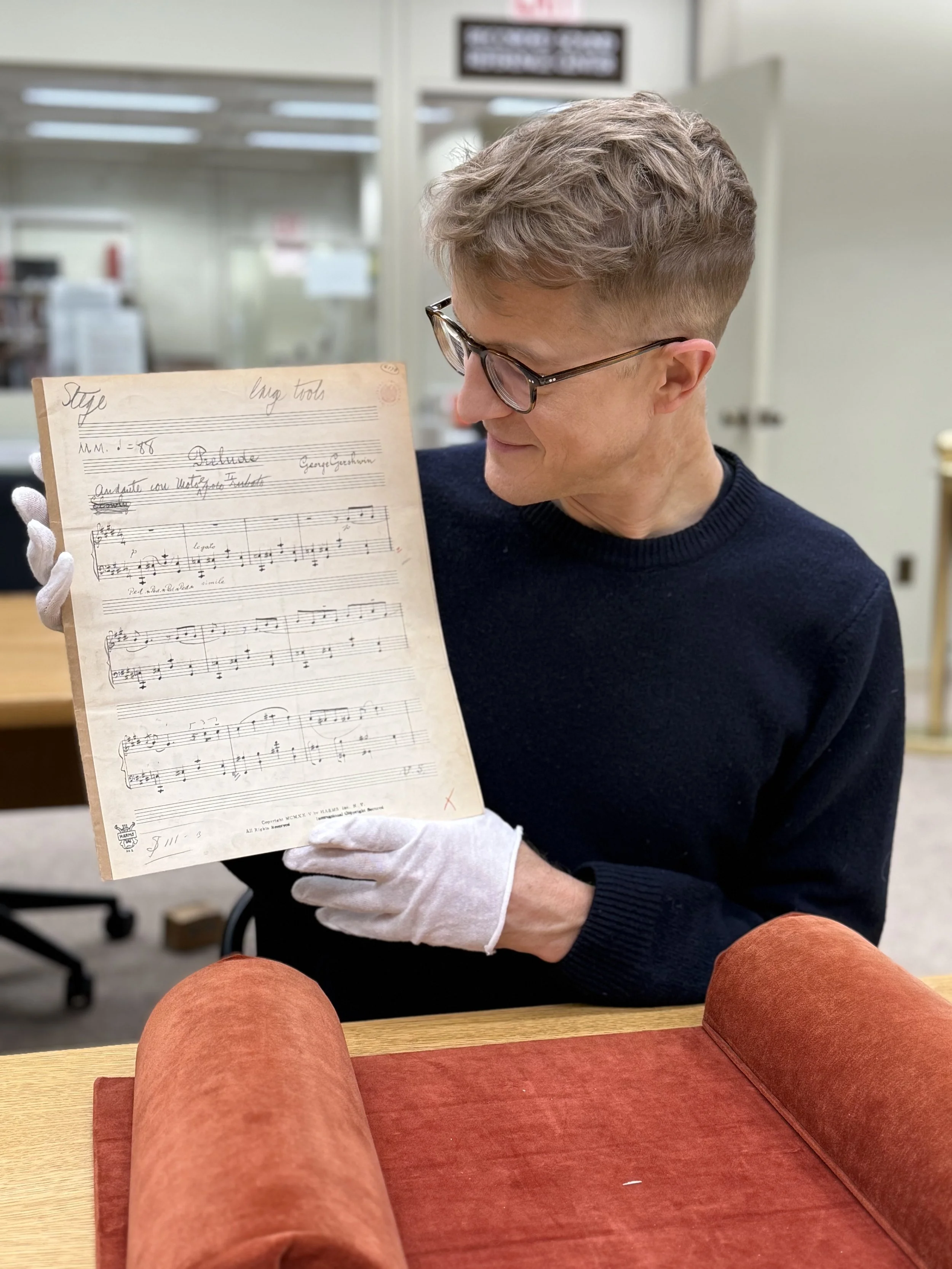
At the Library of Congress with the manuscript of Gershwin’s Second Prelude.
“Gershwin in Vienna” owes its existence to innumerable supporters, and in particular to the generosity of Guy and Renée Pipitone, Barbara Hannigan, Benjamin Zander, Thomas Dreeze and Evans Mirageas, Robert Franz, Courtney Lewis, Sameer Patel, Elizabeth DeShong, Timothy Myers, Douglas Williams, Nadine Secunde, Okka von der Damerau, Peter Hoare, Michael Egel, Craig Urquhart, Mark Gibson and Kirstin Greenlaw, Richard Scerbo, Dan Cooperman, Constance and Joseph Tasker Jr., Rebecca Parman-Crozier, Zuby and Anil Patel, Dorian Vandenberg-Rodes, Jessica Osborne, Pat and Ken Nilsestuen, Aik Khai Pung, Dee Linda Hammer Allen, Rich and Keshin Renee Dee, and Katharine Eltz-Aulitzky and the American Austrian Foundation. Special thanks especially to the Arnold Schönberg Center in Vienna and the Schoenberg family in California.
This album is dedicated in loving gratitude to Herbert and Vicki Hammer.
Selected Press
“Gershwin and Schoenberg. So much pleasure in highlighting their music – there was well more than tennis that made them so mutually respectful and appreciative. Levi Hammer’s recording ‘Gershwin in Vienna’ gives us all the opportunity to musically delve into their friendship.” - Larry Schoenberg, son of Arnold Schoenberg
FIVE QUESTIONS WITH LEVI HAMMER - Ron Schepper, Textura, June 2026
Excerpt: “There’s a fine line between my work as a conductor and as a pianist. I can’t imagine doing one without the other. Of course there are great conductors who are not pianists – like Gustavo Dudamel or James Gaffigan, to name two colleagues I deeply admire – and I think the thing that most helps a conductor coming from the piano is a sense of harmony, because as a pianist, you’re forced to “think harmonically” to mentally process the sheer amount of material. Another way to say it is that you have to simultaneously think horizontally and vertically. So when I play a fugue, I have the sense that I’m conducting the various fugal voices, and when I play the Berg Sonata I’m thinking of the orchestra – I mentally orchestrate certain lines to sound like Berg’s Violin Concerto, with a theme presented in a muted trumpet or a violin section playing in octaves with intense pianissimo vibrato to the very end of a high sustained note. Maybe this is just in my imagination, but I try to find these orchestral colors on the piano. An early piano teacher of mine felt that pianists make the best conductors in the same way that U.S. state governors, with their executive experience, go onto make the best presidents. Again, I don’t know if this is true, but it’s an interesting thought experiment. Yes, I’ve assisted some really remarkable conductors, and I still occasionally prepare operatic productions for other conductors I especially admire. Most importantly, it’s FUN! I can’t adequately summarize these great artists in a few lines, but I’ll try. From Barbara, I’m inspired to be a true artist, to work damned hard and to fully invest in the colleagues we have the privilege of collaborating with. In Simon, I see the music just BURST out of him – he’s not so much conducting, as much as BEING music, which I guess is real conducting, and it’s incredibly inspiring. I just prepared a new Walküre production in Los Angeles for Gustavo, and I feel like I become a better conductor just being in his orbit – his endless energy is matched by his mastery of the craft of conducting, and I learn so much every time I’m with him. I knew Maazel early in my development when I was terribly intimidated by his brilliance, and I wish I could learn from him now as a more mature musician – he was an idiosyncratic conductor, renowned for his technique, but he told me that more important than technique was “projecting” – his word – the music to the musicians, which I guess is the crux of conducting. I didn’t grow up in opera, and even after having done so much of it in the last ten years in Europe, my repertoire isn’t expansive – mostly Mozart, Wagner, 20th Century masterpieces, and of course the American musical theater of my adolescence! Being a pianist helped as I learned the craft, but now with the perspective of a few years, I feel that my opera experience has most influenced my symphonic work. I had stellar training, but I could get myopic in my studying, obsessing over details sometimes at the expense of the big picture. And in opera, you crash and burn if you don’t keep an eagle-eyed view of your musical surroundings – and the same idea applies to a Haydn or Mahler symphony.” – Levi Hammer
“In Hammer’s hands, [the Berg Sonata] is impassioned and rich-toned. The pianist again draws out the score’s responsive and imitative elements strongly; his playing at the beginning of the central developmental episode is conspicuously lovely and inwardly focused…. He plays all of this fare with an affection, style, and understanding that reflect his long experience with it and the album’s musical rewards far exceed the not-inconsiderable intellectual pleasures to be had from encountering these composers and works side-by-side.” - Jonathan Blumhofer, The Arts Fuse
“While building a versatile career as a symphonic and operatic conductor, soloist/recitalist and chamber musician, Hammer's conviction that the surface differences between Gershwinian melody and Expressionist atonality conceal affinity has only deepened…. Hammer makes a case that the superficially yin-and-yang musical worlds of Tin Pan Alley and atonality are kindred spirits.” - Paul Bodine, Classical Music Daily, August 5, 2026 (Interview)
“Levi Hammer captivated the audience during his latest performance…. More than a historical exploration, the evening also served as a musical autobiography of Levi Hammer, uniting his American roots with his ongoing European artistic journey. At the piano, Hammer created a bridge between worlds, between jazz-inflected American soundscapes and the rigorous, expressive language shaped in Vienna.” - Larissa Porsche, American Austrian Foundation
Interview on “Evening Eclectic” with Dave Lake, WRUU 107.5 Savannah
“Levi Hammer spielt Gershwin mit viel Swing, kräftig-robust, mit gelegentlicher Zuspitzung, zupackend, ohne übertriebene Agogik. Die Klaviersonate op. 1 von Berg und Stücke von Webern und Schönberg interpretiert er hingegen mit einfühlender Differenzierung, eher weich-geschmeidig und ohne dissonante Schärfe. Freilich ergänzen sich solche Gegensätze kaum, doch stimuliert die Werkfolge stets aufs Neue die Aufmerksamkeit, ja die Neugier, Musik in all ihrer stilistischen Ambivalenz zu erleben.” - Giselher Schubert, Fono Forum, August 2026
“Hammer draws convincing parallels between the Lyric Suite and An American in Paris” - Dave Olds, The Whole Note, Volume 31 No 5, May & June 2026
“Hammer humanizes with his expressive touch. Contrasts in pacing, mood, and dynamics help elevate the performance. Hammer's rendition of Berg's sonata is as scrupulous, with every developmental detail handled thoughtfully. Anyone thinking the music of the Second Viennese School lacks emotional intensity need only listen to this performance to be enlightened otherwise.” - Ron Schepper, Textura, June 2026